

Tea, dirties and cutlery trolleys
Tea, dirties and cutlery trolleys help move crockery, trays and cutlery safely through busy service areas. We manufacture, import and supply stainless steel trolley options from Cape Town for restaurants, hotels, canteens, takeaways and food service kitchens.
What these trolleys are used for
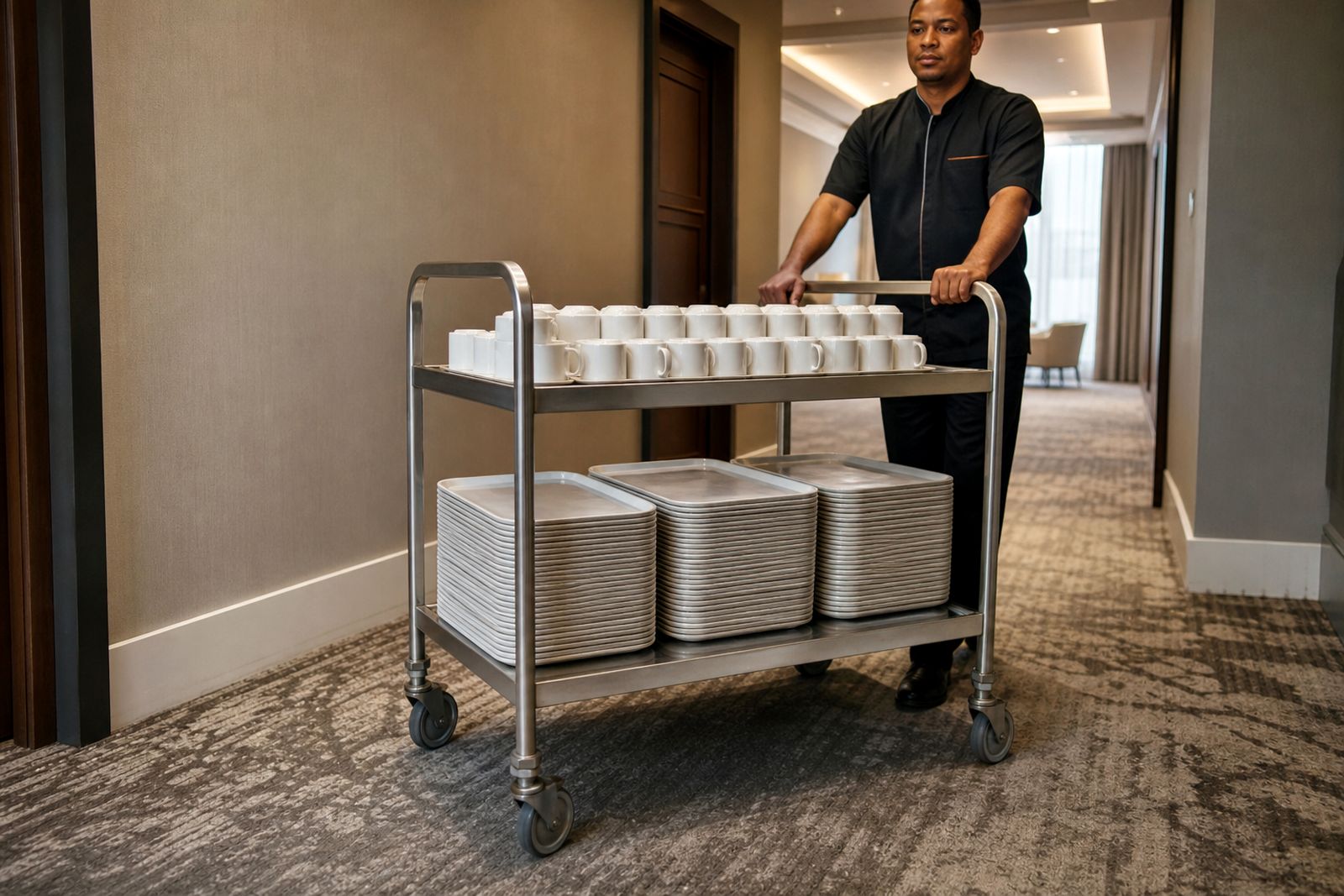
Tea trolleys, dirties trolleys and cutlery trolleys are made for the back and forth work between service points, sculleries, dishwash areas and storage. In a canteen or hotel service passage they help staff move cups, saucers, trays, plates and cutlery in fewer trips, with less breakage and less strain on the operator. In smaller takeaway kitchens they are often used for bussing, tray return and keeping washed items together before put-away.
We supply practical stainless steel units suited to commercial food service conditions in Cape Town and across the Western Cape, with freight to other parts of South Africa. For coastal sites, stainless steel remains a sensible choice because it handles damp air better than painted steel, provided it is cleaned properly and not left with salt or chemical residue sitting on the surface.
- Tea trolleys for cups, saucers, mugs, kettles, flasks and service items
- Dirties trolleys for used plates, trays and bussing bins moving to wash-up
- Cutlery trolleys for sorted spoons, forks, knives and serving utensils
- Multi-shelf trolleys for general transport between prep, serving and wash areas
Sizes, layouts and practical limits
Most sites choose from compact, standard or long-body trolley layouts depending on aisle width, lift access and the amount of crockery moving per service. Compact units suit coffee stations, ward kitchens and narrow passages. Standard units suit general restaurant and canteen use. Long-body units are useful where there is a straight run between service and wash-up, but they need a wider turning circle.
Common formats include two-tier and three-tier shelf trolleys, open-frame tray trolleys, bin-support dirties trolleys and cutlery clearing trolleys with top trays or removable inserts. Working limits matter. These trolleys are for hand-moved kitchen items, not for stockroom pallets, gas cylinders, bulk drums or rough yard surfaces. If staff must cross thresholds, paving joints or loading ramps, larger castors and better bump protection are worth specifying, otherwise the trolley can rattle and cups may shift.
- Compact footprints suit narrow passages and small service lifts
- Standard footprints suit most restaurant and hotel back-of-house routes
- Long-body layouts carry more per trip but need more room to turn
- Deep shelves help with trays and bins, while flat shelves suit crockery stacks
- Cutlery sections can be added for sorting before or after wash-up
Where floors are badly uneven or routes include outdoor sections exposed to rain and grit, a light catering trolley may not be the right tool. In that case tell us about the route and we can guide you toward a heavier fabrication or a different handling setup.
Where they suit, and where they do not
These trolleys suit restaurants, hotels, school and factory canteens, retirement dining rooms, hospital food service areas, cafés and event venues. They are especially useful where staff need to clear tables quickly and move mixed items to a scullery without hand-carrying stacks of crockery. In kitchens affected by power cuts, trolley movement still keeps dish return and service flow going when powered equipment is temporarily down.
They are less suitable in sites with steep ramps, broken quarry tiles, open gravel access or very tight corners between swing doors. A trolley that works well in a smooth mall food court corridor may be frustrating in an older building with thresholds and narrow turns. If your route passes through customer areas, quieter castors and a neater enclosed cutlery layout may be a better choice, and it often helps with presentation too.
For beachside premises and harbour-side kitchens around Cape Town, rinse-down discipline matters. Stainless steel performs well, but salty residue, chlorine splash and strong degreasers left on the frame will shorten the life of castors and fittings if they are not cleaned off.
Site needs before you order
Tea, dirties and cutlery trolleys do not usually need fixed electrical, gas or plumbing services, which makes them easier to add to an existing kitchen. The important checks are route width, door clearances, floor condition and the place where the trolley will stand when not in use. If it must park near a dishwash area, think about splash, drainage and whether staff can still pass safely when the unit is loaded.
Please measure the narrowest doorway and the tightest turn, not only the open kitchen floor. Also note whether your route includes service lifts, staff ramps or a threshold lip at fire doors. Small details like that can make a standard trolley awkward in daily use.
- Clear route widths and door openings
- Floor finish such as smooth tile, epoxy, vinyl or rough screed
- Thresholds, ramps and lift sizes
- Whether the trolley is used in customer-facing spaces
- Need for brakes, bump rails, handles or enclosed sections
If your project forms part of a wider kitchen fit-out, municipal and compliance requirements still apply to the overall site layout, and any related services should be handled by a qualified installer where needed.
Care and daily cleaning
Good trolley life comes from simple daily care. Wipe food spills early, keep castors free of string, labels and broken cutlery ties, and do not leave wet cloths or chemical buckets standing on shelves after shift close. In coastal kitchens, a fresh water wipe-down helps remove salt film. Avoid steel wool and harsh abrasive pads because they can mark the surface and make later cleaning harder.
Castors should roll freely without dragging. If a trolley starts pulling to one side, check for wrapped debris or a bent mounting rather than forcing it. Shelves and trays should also be checked for edge damage if crockery is being loaded too fast at peak periods. A quick end-of-day check saves trouble later, and it keeps the route safer for staff.
- Use mild detergent and warm water for routine cleaning
- Rinse chemical residue off after deep cleans
- Dry shelves and frames rather than leaving them wet overnight
- Check castors and brakes regularly
- Do not overload shelves with dense stock items not meant for service trolleys
What to tell us when you enquire
To recommend the right tea, dirties or cutlery trolley, we need a clear picture of the route and the items being moved. A few photos and some basic measurements are usually enough to start. If you need a custom stainless steel trolley made to suit an unusual passage, bin size or shelf spacing, say so in the enquiry form and we will advise on practical options.
Please include what the trolley carries most often, how many levels you want and whether it must fit under counters or into a lift. Also mention if your site is near the sea, if staff move over rough tiles or if the trolley needs to be washed down often. Those details matter more than many buyers expect, and they help avoid ordering a unit that is neat on paper but wrong on the floor.
- Overall size limits in millimetres
- Number of shelves or sections needed
- Type of items carried such as crockery, trays, cutlery bins or bussing tubs
- Whether you need brakes, bumpers, handles or enclosed sides
- Delivery town in the Western Cape or elsewhere in South Africa
Use the enquiry form on our contact page and we will come back with suitable options. Ask for a quote.
What our Catering Equipment customers say
Verified Google reviews
Questions we get asked
Can these trolleys be made to suit a narrow passage or service lift?
Yes. Tell us the narrowest doorway, lift opening and turning point, and we can advise on a more suitable footprint or a custom fabricated option.
Are tea and dirties trolleys suitable for outdoor use?
They are mainly intended for indoor food service routes. Short covered sections may be manageable, but rough paving, rain and grit are hard on castors and make crockery less stable.
Do I need any special installation for a trolley?
Usually no fixed installation is needed. What matters is the route, floor condition, storage spot and whether the trolley must work near wet areas or customer-facing spaces.
Also worth a look
Ask for a quote
Send a note through our contact form with the equipment you are looking at, the kind of kitchen it is for and your delivery town, and our sales team will reply with a quote.
Open the contact form